Overwatch 2 Weekly Recall: Neon Junction AMA Recap (28th July 2026)
The Overwatch 2 team's AMA exposed the layered narrative woven through Neon Junction. From Kiriko's father's workshop to the Yokai's front operations. Here's what those details actually tell you about where the game's story is heading.
Neon Junction is not simply a map. According to the developers who built it, it's a narrative anchor. One that deliberately mirrors Hanamura's role in the Overwatch world but inverts it entirely. Where Hanamura celebrated traditional Kyoto and the Shimada Clan's heritage, Neon Junction represents a vibrant, modern Tokyo and the Hashimoto faction's contemporary power. That contrast is deliberate worldbuilding, not decoration.
The AMA recap reveals that the map's environmental storytelling runs deeper than most players will ever notice during a match. Spectral Systems, the electronics shop near defender's forward spawn, functions as a front for Yokai operations. Complete with Kiriko's bike stationed outside and fox-inspired graffiti. Inside, schematics for both Mizuki's healing kasa and Hanzo's Mythic Weapon Tokyo Rebel sit on display. That's not Easter egg decoration; it's evidence of how Nobuto (Toshiro's son, presumably) would upgrade Hanzo's arsenal if given the chance. The developers imagined a specific technical collaboration between two characters across factions, then embedded it into the environment.
The Zuiko-za kabuki theatre at the third point carries similar narrative weight. It's currently staging a play called Divide of Brothers, a title that directly mirrors the Shimada-Hashimoto conflict, and the theatre's back office belongs to someone significant enough to warrant a glowing parade float being smuggled through the front door. The developers did not name who runs that office, but the staging suggests a character reveal connected to Shion and Mizuki's ongoing story arc. The payload itself carries colour-coded hints tied to Toshiro's workshop tanks, linking the escort objective to the map's lore rather than treating it as a separate mechanical element.
What matters here is the development philosophy on display. Lead level designer Ryan Smith, art director Peter C. Lee, and worldbuilding producer Ren Soanes confirmed that map design, narrative, and hero development evolved together rather than sequentially. The Tokyo setting was not chosen to fit an existing story; the story deepened as the setting developed. This year, the team has committed to updating older maps to support major story beats. Gibraltar is explicitly mentioned as receiving future updates. Neon Junction is the template for how that integration works.
For players, this means environmental details are now functional lore delivery. You cannot engage with Overwatch's narrative at competitive speed, but the map rewards slowing down, noticing the mural of an Oni hunting a dragon (Hashimoto versus Shimada), checking the fictional anime posters in attacker spawn, and reading Spectral Systems' inventory. The developers know players are focused on the match; they've designed the world to reward those who aren't, at least between rounds. That approach signals a studio confident enough to embed story in spaces most players will rush through, trusting that some will stop and piece the world together.
Full Patch Notes
▲ BuffGreetings, gamers! Last week, a few of the folks behind the glittering lights and mecha statues of our newest Hybrid map rallied to answer some community questions on the Overwatch subreddit. They touched on everything from complex map design concepts to Tokyo-tastic inspirations and…bees?
Lead level designer Ryan Smith and associate art director Peter C. Lee captained the Neon Junction function, joined by worldbuilding producer Ren Soanes, senior concept artist Andrew Menjivar, and senior art supervisor Phil Wang.
If you’d rather face Shion’s wrath than search the comments for our developers’ insights, we’ve got you covered with a recap. Check out the full AMA here or jump to your favorite topic below. Enjoy!
Lore And Little Details
What’s the story behind the map? For example, in Junkertown we’re trying to escort the payload with gold on it cos of Junkrat.
Andrew: Hint! Check the tanks at Toshiro's workshop. Then check the payload as it approaches the kabuki theater. Note the color.
What's the lore about the third point?
Ren: The Zuiko-za is a kabuki theatre run by some very questionable people. The theatre is currently putting on the play Divide of Brothers. If you venture into the very back of the theatre, you’ll find the lobby for a certain someone’s office…The whole operation probably has something to do with that glowing parade float that they’re doing a bad job of sneaking in the front door.
Are there any other older maps that'll be getting lore-inspired redesigns like Gibraltar as this year’s storyline progresses?
Ren: This year, Team Four has really made a commitment to narrative. When possible, we’ll be updating maps to support major story beats, though each update can range in size. Additional updates are coming much sooner than you think! And hopefully Winston gets around to fixing up Gibraltar, too.
What are some hidden details designed in Neon Junction that many players may not notice due to the fast-paced nature of this game?
Peter: There are quite a few, and I'm sure many of you have already discovered some of them! I'll try to avoid the more obvious ones and share a few that come to mind. Some of these might be a bit of TMI... but that's what an AMA is for, right?
- In the attacker spawn, there's a movie theater in the back. The posters hanging outside are actually fictional anime posters our team created based on the kinds of shows we'd love to watch ourselves. There are romance films, adventure stories, mecha anime, and more.
- As Andrew mentioned, if you look above the masks in defender's spawn, you'll find a mural depicting an Oni hunting a dragon. The Oni (along with the tiger) represents the Hashimoto, while the dragon symbolizes the Shimada clan. It's a visual metaphor for the current relationship between those two rival factions.
- If you look at the red building labeled Pylon, there's a fashion boutique called AW on the second floor. According to the storefront display, they've just received a brand-new fashion collection!
- Behind the attacker's forward spawn, you'll find a small electronics shop called Spectral Systems. Rumor has it that members of the Yokai frequently visit this place... Maybe you'll spot some clues inside.
- Finally, near the defender's forward spawn, you'll find what used to be Kiriko's father's workshop. This was where he experimented with Animal Spirit Weapons using the spirits of different animals. If you imagine the massive forge running at full power, it's a fun way to picture what that workshop might have looked like when it was still in operation.
One of our favorite parts of building Overwatch maps is hiding little stories throughout the environment. We know players are usually focused on the match, so it's always incredibly rewarding when someone slows down, notices these details, and starts piecing the world together.
What is a worldbuilding detail on the map that you feel has been overlooked by the player base?
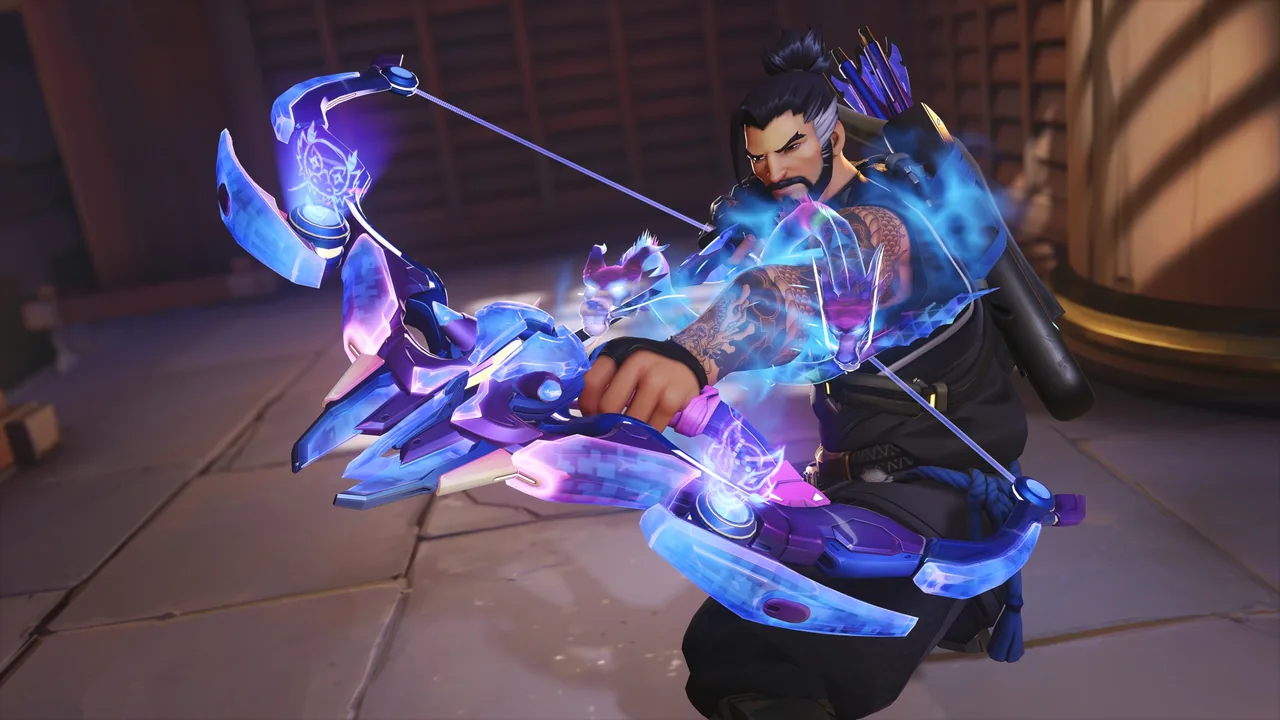
Ren: In the shopping mall spawn room, there is an electronics store called Spectral Systems. If you look closely, it’s a front for the Yokai’s operations in Tokyo. Kiriko’s bike is stationed outside and there’s a fox-inspired graffiti tag on the wall. But my favourite detail is that Nobuto has schematics for Mizuki’s healing kasa and Hanzo’s Mythic Weapon Tokyo Rebel. Jamming with the Mythic, Narrative, and Worldbuilding teams, we imagined Hanzo’s Mythic Weapon was how Nobuto would upgrade Hanzo’s bow if he had the opportunity to collaborate with Toshiro. It’s probably a little too flashy for Hanzo’s personal taste!
Inspiration Station
Love the vibe of this map! Was there a specific city or district in Japan that served as the inspiration for the look?
Andrew: Yes! We looked at various districts of Tokyo. Shibuya, Akihabara, and Ginza were some of the biggest sources of inspiration for us.
How did the team land on the theming for Neon Junction? Was the year long story beat with Shion and Mizuki already in development when you guys to decided on a Japanese map? And what were the design goals for map, were there any challenges there in bringing something new to the game from both a theme and gameplay standpoint?
Peter: There were a lot of factors that came together in creating Neon Junction. One of the first questions we ask ourselves when starting a new map is, "What kind of place would players be genuinely excited to explore?" Before we're developers, we're Overwatch players too, so we spend a lot of time thinking about locations that would be fun, memorable, and inspiring to experience.
A map set in Tokyo had actually been something I wanted to do for a very long time. When I worked on Hanamura years ago, we focused on highlighting the traditional beauty of Kyoto. I always imagined that one day we could create a map that celebrated the other side of Japan, a vibrant, modern Tokyo, and together they would paint a more complete picture of the world. Just like Yin and Yang.
Since Hanamura was centered around the Shimada Clan, Neon Junction also felt like the perfect counterpart to represent the Hashimoto. That contrast between tradition and modernity, and between the two rival factions, made the setting feel especially meaningful.
As development continued, the map, the story, and the heroes naturally evolved together. It wasn't really a case of one coming before the other, they all influenced each other throughout development. The map helps deepen the heroes, and the heroes in turn make the map feel richer and more alive.
Seeing players connect those dots and enjoy exploring the world we've built is honestly one of the most rewarding parts of our job. That excitement from the community is what motivates us to keep creating even more memorable places in the future.
Andrew: We wanted to explore a theme that was both unique to Japan and highlighted a vibrant future version of Tokyo. City pop acted as a throughline for maintaining a fun, vibrant tone throughout the space. As for the story, narrative details can always change throughout development, but we knew at the very least that we wanted a heavy Hashimoto presence somewhere on the map. That eventually became the skyscraper you see in the distance. As Shion and Mizuki's story became more solid, we were able to support the narrative with details placed around the map to better sync with the overall story.
I'm a big fan of City pop, so when Dion mentioned this map was inspired by it, I was so excited, the map delivered on those vibes perfectly imo. I'm just curious what are some highlights/challenges about trying to adapt a music genre (or the vibes at least) into an actual map and in which ways did it influence the decisions you'd make when building it? Ty for my favorite map, keep up the great work!
Andrew: Hello! I'm so glad you love the map! It's become one of my favorite maps that I got to work on. One of my goals with Neon Junction was to deliver a more inspired take on a futuristic Tokyo, and I wanted to try and set Neon Junction apart from our other Japanese maps which leaned more heavily into traditional elements.
Early on, cyberpunk was floated around as an aesthetic to pursue, but I personally try to engage with cyberpunk as a genre rather than just an aesthetic. The more dystopian futures found in traditional cyberpunk stories didn't feel like it meshed well with the more utopian ideals of Overwatch's world, so I wanted to find a more fitting source of inspiration. And that's where Japanese city pop came in! Something bright, fun, and uniquely Japanese.
When I think of city pop, I think of the dazzling neon lights, twilight summer evenings, and a particular moment in Japan's pop culture history. I envisioned a future version of Tokyo that was going through a neo tech-renaissance, echoing the real-life Japan tech boom of the 70s-90s. So I took some visual cues from tech of that era (e.g. cassette players, decks, and game pads) and that became the visual hook for some buildings and minor details found throughout the more urban areas of the map.
Map Design Deep Dives
Was it pre-determined that it would be a Hybrid map? How early in the design process is that established?
Ryan: From day 1! The mode, The location, narrative beats, and design intentions are the first things we try to solve before jumping into the editor.
What's an example of design philosophy that has changed (if anything) over the last five-ish years of designing maps? Additionally, do you guys have an expectation of how certain heroes interact with jumps or gaps when designing maps?
Ryan: How we design choke points has certainly changed over time. Especially since the early OW1 days. Over the course of early OW development, the team focused on a few gameplay elements they felt were some of the secret sauce of the game. Tighter chokes was one of those things. As the meta, heroes and our players naturally evolved after release, we've slightly loosened our philosophy around the scale and amount of routes through a choke. I would say though, Tokyo has some pretty tight choke points and they'll always be a pillar of our map designs!
Short answer to the second one is, yes. We design the maps to support and service the heroes so we're constantly playtesting them and fine tuning how every hero can interact with the space. Overall, every hero should have a comfortable and fun experience in every map...BUT we definitely flex that a bit so there are specific areas we will build for X type of hero or we notice X hero can do a specific action while others can't and we keep it in. Balance through playtesting is key.
I really enjoy how Neon Junction’s 2nd point is a relatively flat section so ground-based heroes can play well while not being narrow and congested like other maps. It still feels like you can take angles on flanker heroes and the train running through prevents Snipers from fully locking down the area. Was this a planned design choice from the beginning or something that occurred as you were building the Map?
Ryan: There's a lot of things we plan for and other things that are happy accidents along the way. This one we actually planned for! The sightlines from the train platform to 2nd were something we had to adjust the geo for and were looking out for while building the map. The corner bend up the incline before reaching the point was something we had to toy with along with the corner cover that blocks the view to the point. We're constantly adjusting the pinch points and angles of our roads and buildings to avoid long sightlines.
How was the map approached from the perspective of lane design, and was there an active effort to avoid one side of the map being the clearly best angle in most situations?
Ryan: This is a great question. While it sometimes seemingly works out this way - we don't follow the 3 lane philosophy that some other games do while designing our maps. Without giving away our secrets, it’s more about when and where players expose themselves to the enemy team and the timing around guiding players back to their team, the enemies, and the objective. Sometimes the spaces we build are wide enough that extending the area or adding another lane ends up splitting the teams too much or give one team an unfair advantage or a super quick route to the objective that allows them to circumvent the enemy team.
Are you planning on making adjustments to the map based on community feedback?
Ryan: We are definitely open to making geo adjustments to new maps sooner rather than later! We made some gameplay adjustments that went live on 6/30. The payload is slightly slower and the delays for the gates/payload movement were increased.
Can you guys speak to any lessons learned from less popular maps, and how they informed Neon Junction's design? How does play testing internally compare to the complaints of a zillion players playing the map on launch?
Ryan: I wish there was a silver bullet in figuring out why some maps perform better than others. It can be very nuanced. From the start with Tokyo, the idea was "This will be the 1st new Hybrid map since Rio at OW2 launch...what do we want to do different, what do people love about the more popular hybrid maps?" A lot came out of that, and we looked at the classic maps to draw inspiration.
Playtesting is the most valuable thing for any designer. We can never account for the reception of the millions of players on launch, but we do our best to cast a wide net to account for as many opinions and playstyles as possible. We do multiple playtests a week within the team and our skills vary quite a bit. When we feel like the feedback is going too far in one direction, we get other people to play and see what they think.
Don’t Bee Late For The Train!
Are there triggers for the train or is it a randomized event?
Ren: After the first point unlocks, the train departs for the station every fourteen seconds, and travels for a total of 3.5 seconds.
The last 2 maps have had Random occurrences happen (Antarctica Freeze) and (Neon Junction Train), will this be a running trend for all new maps/reworked maps going forward?
Ryan: The response to the environmental hazards in Antarctic Peninsula and Tokyo has been great and they're definitely something we're a bit more open to playing with (and we do have some others planned) but I wouldn't say that it’s a goal for us to put one in EVERY new or reworked map.
Hello! In Neon Junction, there is a separate room with a beehive, and when you damage the hive, you take damage yourself.
So, is there any chance that if a player dies from the beehive, the kill icon wouldn't be the standard one, but would feature a bee symbol instead? I think it would be fun if you added an Easter egg like that.
Ren: We already pestered our UI/UX team for a cute bee icon and it’s been checked in by engineering so it’s coming very soon. We’re so glad y’all enjoy the bees as much as we do!
Phil: We had fun making the honey shop and wasn't sure how the small damage would be received by players. I think it turned out being a really fun detail. props to our technical artists and vfx team!
Sources
Stay on top of every update — find all the latest patch notes and gaming news at XP Gained. Join our Discord for live patch note alerts and discussion.
Written by
Nathan LeesGaming journalist and founder of XP Gained. Covering patch notes, breaking news, and updates across 160+ games.
Related Posts

Overwatch Weekly Recall: Neon Junction AMA Recap Notes (28th July 2026)
The team behind Neon Junction answered community questions about the map's lore, hidden details, and how Tokyo's modern vibrancy contrasts with Hanamura's tradition.

Overwatch 2 Patch Notes (1st July 2026)
A quick hotfix lands today with some relief for the Community Crafted event grind.
Overwatch Patch Notes (30th June 2026)
Blizzard's new Community Crafted mode lets four pro players redesign Overwatch's entire roster, and the changes are wild.