Steam Deck's AI Upscaling Upgrade Confirmed for 2027
AMD has confirmed that its AI-powered FSR 4.1 upscaling technology will arrive on RDNA 2 hardware, including the Steam Deck, in early 2027. RDNA 3 desktop cards get it first in July.

Every Steam Deck owner just got a reason to hold off on upgrading. AMD's SVP of Computing & Graphics, Jack Huynh, posted on X yesterday that FSR Upscaling 4.1, the company's AI-driven upscaling tech, will officially come to RDNA 2 GPUs in early 2027. The Steam Deck runs on RDNA 2 architecture, which means Valve's handheld is squarely in scope.
FSR 4.1 launched back in March exclusively for AMD's newest RDNA 4 cards like the RX 9070 XT. AMD had repeatedly said that the AI upscaling required newer hardware to function, leaving older GPU owners out in the cold. That stance softened yesterday. Huynh confirmed RDNA 3 cards (the Radeon 7000 series) will receive FSR 4.1 this July with support for over 300 games at launch, and RDNA 2 follows in early 2027.
This is a bigger deal than it might look on paper. The Steam Deck's GPU has always been its bottleneck; it's a handheld pushing desktop games through a relatively modest chip. AI upscaling at this level could extend the device's useful life by letting it render at lower native resolutions while producing a sharper final image. For a piece of hardware that costs a fraction of a desktop GPU, getting access to the same upscaling pipeline as a 9070 XT is a serious upgrade. I'm curious how much of a visual and performance difference this makes on the Deck's small screen and limited power envelope, because the gains could be dramatic or they could be constrained by the hardware's other limitations.
It also matters for the Steam Machine, Valve's upcoming RDNA 3-based living room PC, which will receive FSR 4.1 support even sooner in July. As GamingOnLinux noted, the open-source Mesa driver situation on Linux still needs to catch up; official AMD support should give Mesa and Proton developers the green light to enable it by default, but that rollout will take additional time.
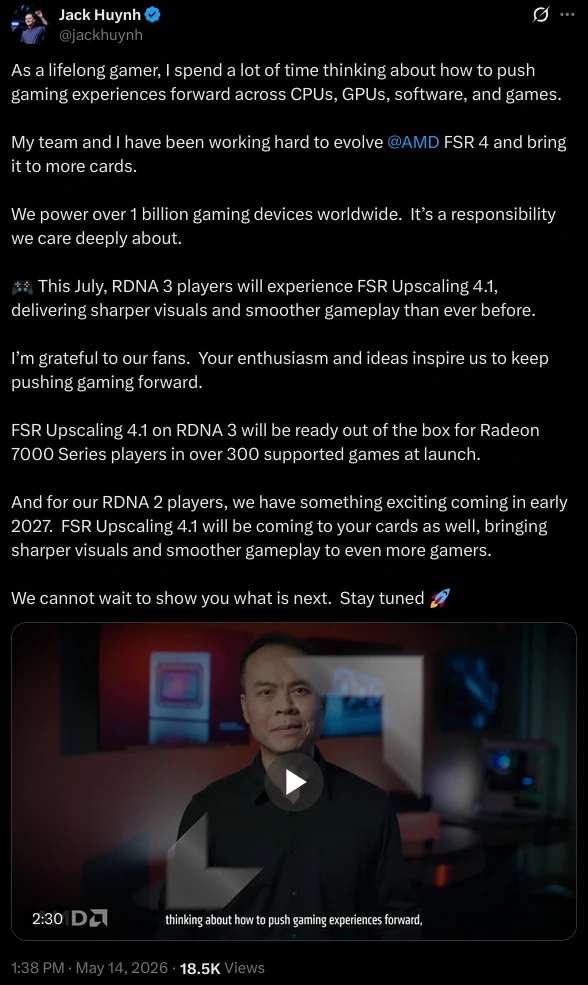
Community hackers had already managed to get FSR 4 running on older AMD cards through leaked source code, so the demand was never in question. AMD making it official removes the need for workarounds and, more importantly, means game developers can target the feature knowing it has broad hardware support. Huynh's post mentioned that AMD powers over one billion gaming devices worldwide, and bringing AI upscaling to that install base rather than gating it behind the newest silicon is the right call, even if it took public pressure and accidental leaks to get here.
Sources
Stay on top of every update — find all the latest patch notes and gaming news at XP Gained. Join our Discord for live patch note alerts and discussion.
Written by
Nathan LeesGaming journalist and founder of XP Gained. Covering patch notes, breaking news, and updates across 160+ games.
Related Posts

Steam Controller Finally Works in KCD 2
Valve's latest Steam Beta update squashes a Steam Controller bug in Kingdom Come: Deliverance II, alongside overlay and Remote Play fixes.

50% Faster Isn't Enough? Valve's Wild Bar for Deck 2
Valve's Pierre-Loup Griffais confirms the company is 'hard at work' on Steam Deck 2, but won't settle for anything less than a generational performance leap over the original.

Steam Hardware Buyers' Addresses Leaked in Cyberattack
Valve is warning European Steam hardware customers that a cyberattack on its shipping partner CEVA Logistics likely exposed their names, home addresses, phone numbers, and email addresses.